Newsletter
 Events

J. Cole's 'The Fall-Off Tour' Wasn't Built on Stage—It Was Built in the Shadows
A lesson in how production choices turn good music into great art


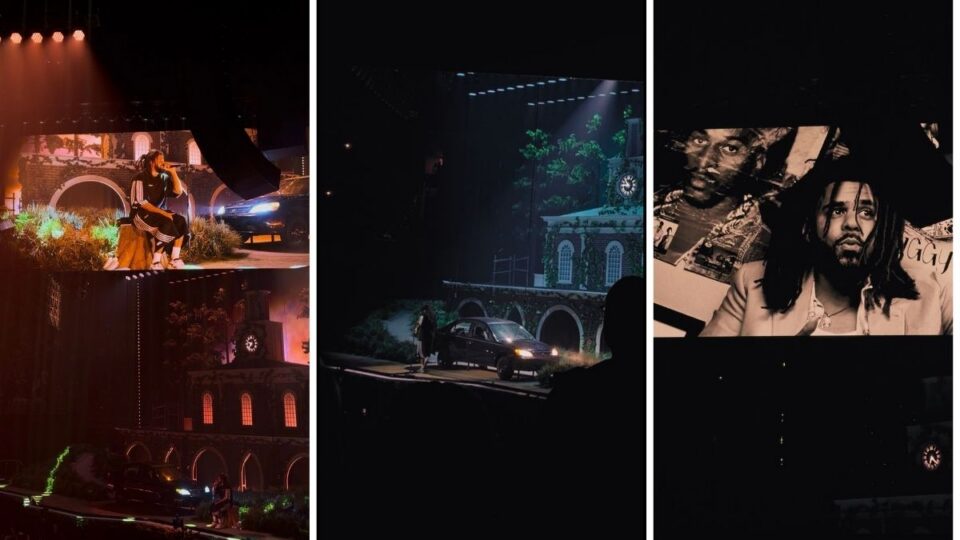
I learned very quickly that talent may draw us to an artist, but the team behind them determines how deeply the performance stays with us.
This was a lesson I first learned in my middle school theater class. After auditioning for the lead role in a play, I was disappointed when I wasn’t cast. Instead, I was assigned to the production crew, tasked primarily with operating the lights. At the time, I looked down on the role. I believed my talent belonged in the spotlight, and I couldn’t understand why I had been relegated to controlling it rather than standing in it.
But as rehearsals progressed, my perspective shifted. I came to see that the crew wasn’t secondary to the performance—it was the very thing that made it possible. Without the people managing the lights, sound and staging, the show simply could not go on. What began as a consolation prize became a fascination that followed me for years, ultimately leading me to a master’s degree in media studies, where I learned to analyze the calculated choices that shape how audiences see, feel and remember a performance. Today, that same understanding shapes my work in brand marketing for the Detroit Pistons, where the architects behind the brand elevate the players and the organization from the shadows, unseen yet felt everywhere.
It’s that same lens I now bring to J. Cole’s “The Fall-Off Tour.” Watching the show last week in Detroit, I found myself drawn not to the performance alone, but to everything around it—the deliberate staging, lighting and camera work the crowd may never consciously notice, yet all of them feel. “The Fall-Off” is not simply a display of one artist’s talent. It is a masterclass in collaborative visual storytelling, where symbolism and intentional lighting prove that an artist’s greatest power is built in the shadows.
With this lens in place, here is what I observed.
Cinematic framing and shot selection made us part of Cole’s story
From the moment it opened, the show announced itself not as a concert, but as a film. One of the first images on the LED screen read “A Film by Jermaine Cole. Based on a true story,” priming us for something more than a performance. With that framing came an intentional visual language: cinematic shot selections that controlled the emotion and pacing of the entire night.
What struck me wasn’t the quality of the footage, but how the shots were chosen and manipulated to heighten each moment. By presenting the concert as a film, Cole and his creative team invited us to read the visuals the way we would read a movie, paying attention not just to what was happening on stage, but to how we were being shown it. Wide shots made moments feel enormous and commanding, larger than the room. Then the camera would pull tight with texture, closing the distance between us and Cole so we could feel the raw emotion in his lyrics. That interplay between scale and intimacy is exactly what a great film does. And it’s what turned a series of songs into a story that pulled in the audience.
Symbolism made Cole’s roots impossible to ignore
Symbolism ran deep throughout the show. With just two backdrops priming the stage—the Market House, a famous landmark in Cole’s hometown of Fayetteville, North Carolina, and Cole’s 2000s Honda Civic—the set was intentionally spare. Yet these two elements became the second and third stars of the show, planting Cole’s roots at center stage.
It’s easy to stop at the surface. Yes, these landmarks represent Cole’s past, but we forget to ask how he’s positioned within them. Almost the entire show, Cole stood with his back to his past and his face to the audience. He spoke about how proud he felt to put Fayetteville on the map, noting that even people abroad had asked about his hometown. His placement did more than honor his past—it symbolized Cole carrying his city on his back, holding it up for the world to see. This was the most powerful part of the show.
Intentional lighting turned every beam into meaning
At most concerts, lighting feels like an afterthought. On Cole’s set, it was pivotal to storytelling; without it, this would have been a completely different show. Cole’s songs are full of emotion and storytelling, and the lights enhance every feeling present. The proof was in the movement.
During his introspective tracks, the lights pulled in tight and still, narrowing the massive arena down. Then, as the beat increased, they swept and surged across the stage, flooding every corner and pulling the crowd back to their feet. That constant push and pull didn’t just decorate the songs; it mirrored Cole’s own journey, guiding us through every high and low right alongside him.
“The Fall-Off Tour” was never just a concert. It was a testament to the craft of a production crew—proof that the creative decisions happening behind the scenes can matter just as much as the performance itself. So, that girl in charge of the lights for her middle school play may have been far more important than she ever knew.
Credits
Dreamville
Creative Director: Scott Lazer
Mgmt/Dreamville President: Ibrahim Hamad
Tour Promoter/Booker: Sascha Guttfreund
Dreamville: Adam Roy, Matty Robinson, Derick Okolie, Walter C. Barnett, MK Kasote
STURDY.
Show Design & Creative: STURDY.
Show Director & Stage Design: Adrian Martinez
Multi Media Director: Justin Sanchez
Head of Content: Jasper Heenan
Executive Producer: Kevin Henry
Producer/PM: Alex Rollier
Project Coordinator: Taryn Snyder
Scenic Art Director & Stage Design: Skylar Elis
Asst. Stage Design & Renderings: Pablo de Larrañaga Aramoni
Technical Drawings: Clear All Visuals
Editor: Sebastian Abreu
3D Modeling: Kai Shinomura
Real-time Designer: Jude Hoy
3D Editor: Miranda Rosales
Screens Production: All Of It Now
Screens Producer: Vishal Sharma
Colorist: Patricio Guerra
Camera Director: Josiah Battles
Lighting Designer: Marcus Jessup
Lighting Programmer: Evan Nichols, Aria Hailey
Related: Hang the DJ Founders on Music’s Power to Unlock Memories and Emotions

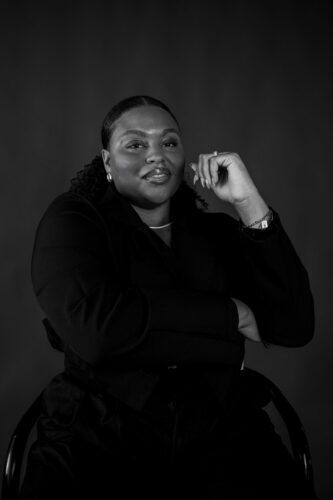
Tianna-Marie Rosser is a brand marketing professional with five years of experience in the sports industry, where she blends cultural insight, creativity, and digital storytelling to build meaningful brand experiences. With a background in Communication and a master’s degree in Media Studies and Practices, she is passionate about using storytelling and media strategy to create culturally relevant moments that deepen how audiences connect with brands. As Brand Experience Manager for the Detroit Pistons, she leads external activations and influencer initiatives focused on reaching new audiences and keeping the brand culturally relevant.