Newsletter
 Events

Why Polymaths Will Shine in the Age of AI
'The only thing left with any value is the gap between competent and great'


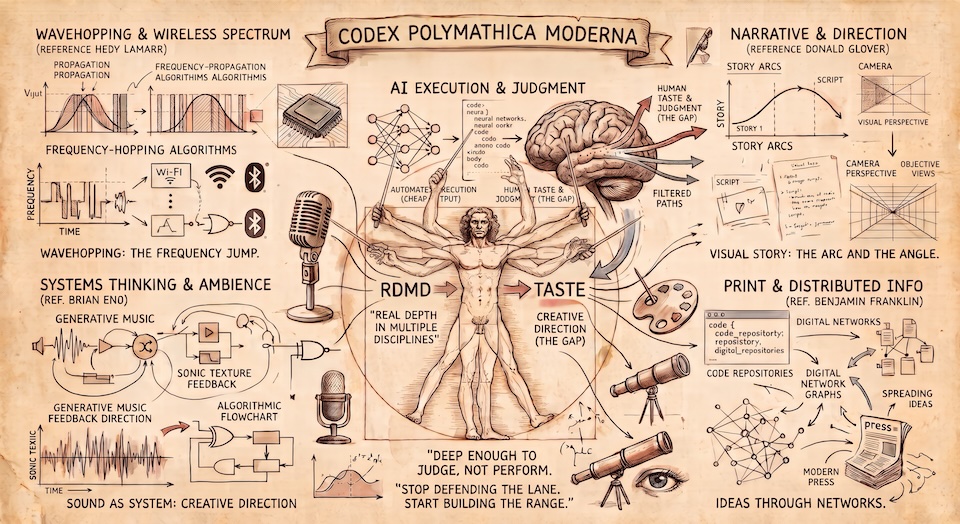
The word “polymath” has been flattened by overuse. A polymath isn’t someone who’s vaguely good at a lot of things. It’s someone with real depth in multiple disciplines—and, crucially, disciplines that feed each other.
Benjamin Franklin wasn’t a printer, writer, diplomat and scientist as a collection of roles. Each informed the other: the printer understood how ideas spread, which made him a better writer. The writer sharpened his diplomacy. Curiosity tied it all together. Hedy Lamarr was a Hollywood star and a co-inventor of frequency-hopping technology that helped lay the groundwork for Wi-Fi and Bluetooth. Brian Eno moves between music, visual art and systems design, building frameworks that generate creative outputs. Donald Glover works across writing, acting, directing and music, with each discipline visibly strengthening the others. None of them were merely “well-rounded.” They had genuine mastery in several places at once, and the breadth was built on depth.
For 20 years, the ad industry treated that profile as a problem. Unfocused. Pick a lane. Go deep. Specialize. That was the path to seniority, and it was sound advice—because execution was expensive and hard. And the only way to be excellent at one thing was to do nothing but that thing for 10,000 hours. The specialist was the safe bet. The generalist was the dabbler.
AI just inverted that, and a lot of people haven’t felt the floor move yet.
AI made competent execution cheap. Anyone can now produce a passable grade, a clean render, a decent first draft. That doesn’t eliminate the need for skill. When everyone can clear the bar of competence, competence becomes worthless. The only thing left with any value is the gap between competent and great—and AI does not hand you that gap. You still have to earn it.
That shift creates an uncomfortable question for many specialists: If the execution layer of your craft is automated, what remains that is uniquely yours? For some, the answer will be less than expected. That’s the anxiety underneath this whole moment, and it’s a rational one.
The response isn’t to panic-learn 10 new tools. It’s to become something the industry has historically undervalued: a master of several trades. And that’s a set of habits, not a personality you’re either born with or not. Here are a few hard won opinions on how to actually do it.
Build outward from genuine curiosity, not from a trend map. The instinct under pressure is to chase whatever skill looks safest—everyone piling into the same “future-proof” discipline at once. Don’t. Forced breadth never sticks; you’ll quit the second it gets boring, and it always does. The disciplines that compound are the ones you’re actually curious about, because curiosity is what carries you past the unglamorous middle of learning something new. The good news is that curiosity also tends to pull you toward adjacent crafts—the writer drawn to art direction and editing, the designer drawn to motion and sound. That adjacency is exactly where the value is. Franklin didn’t pick his fields off a list. He followed what fascinated him, and the results were historic.
Go deep enough to judge, not necessarily to perform. The most common misread of “be a polymath” is “be world-class at everything,” which is impossible and not the point. Instead, go deep enough to know instantly when something is off. You don’t need to be able to grade the film at a master colorist’s level. You need to be able to look at the grade and know it’s fighting the music. That’s a far lower bar to execute and a far higher bar to fake. And it’s the bar that counts, because in a world of cheap execution, the rare skill is judgment, not output.
Treat taste, judgment, and creative direction as the actual job now. When execution is automated, the value moves up the stack—to knowing what’s worth making, why this idea and not that one, when something is technically flawless or completely dead. Those aren’t soft skills anymore; they’re the hard ones. This is exactly what Brian Eno figured out decades early: Build the system, then direct it. The value isn’t in playing every note, it’s in knowing which results are worth keeping. If you’re early-career, stop measuring yourself only by how well you can make the thing. Instead, start building the muscle of knowing whether the thing is any good. That muscle is built the old-fashioned way. By consuming enormous amounts of the best work, paying attention to why it works, and developing a point of view you can defend.
Protect against becoming mediocre at everything by anchoring in one real depth. This is the load-bearing distinction. The shallow generalist—a little of this, a little of that, master of none—doesn’t win in this new world. They just produce mediocrity faster, with better tools. The deep generalist wins. Donald Glover didn’t get range by being casually okay at five things. He got it by being genuinely good at one and letting that standard travel.
Bottom line: Don’t try to do more things. Get good enough at adjacent things to know what good looks like across all of them. Then let the machine do the hands.
None of this requires you to have been born curious about everything. It requires you to start being deliberately curious now, and to stop treating your specialty as a fortress and start treating it as a foundation.
Related: The Dawn of the Hyphenate Creative: Why It Matters