Newsletter
 Events

8 Creators, 1 Script and a Curious AI Experiment
Directors could create as they saw fit. But they couldn't change the dialogue


There aren’t many subjects guaranteed to ruin a dinner party quite like AI. Much of that conversation sits at two extremes: AI is the blazing future of creativity, or it has no place in it. Use it or refuse it. Rather than adding another opinion to the chatter, we decided to run an experiment. One where AI quickly becomes the least interesting part.
“Humancentric” is a multi-artist storytelling experiment conceived, produced and curated by our creative production house MikeTeevee.
We started with a simple premise: If everyone has access to the same tools and narrative, what makes the difference?
We enlisted the help of Oscar-nominated screenwriter Efthimis Filippou, the mind behind The Lobster, Kinds of Kindness and The Killing of a Sacred Deer. He presented us with the heart of the project: a scene about a washed-up police lieutenant who enters a bar, and has an altercation. If you know Filippou’s work, this scene has layers of subtext.
We deliberately chose a dialogue-based story. AI can create wondrous visual worlds; speech is more challenging. We then brought together eight artists from around the world, who use AI as part of their practice, but have diverse styles and processes.
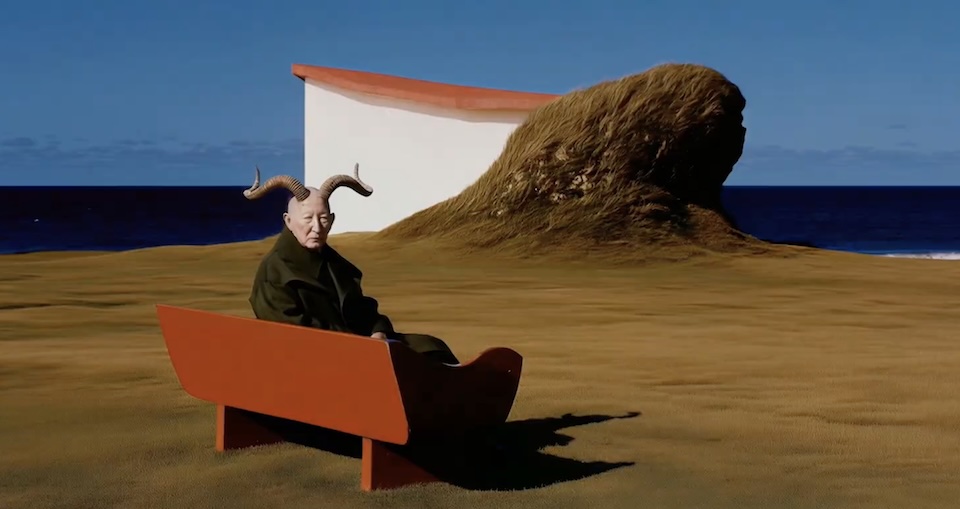
Their brief was simple: Create anything you like, with one rule. Don’t change the dialogue. The result was eight films spanning surreal, noir, dreamlike, unsettling and comic worlds.
Here’s a trailer:
Along the way, “Humancentric” became less like an AI filmmaking exercise and more like a showcase for good, old-fashioned human meddling, where instinct and the filter of personal taste made all the difference.
To expand beyond the screen, “Humancentric” also became a live experience, initially premiering during AI on the Lot in Los Angeles.
Visitors read the original script, spun a wheel of fortune and were sent into one of eight curtained viewing booths. Somewhere between a carnival sideshow and confession booth, the installation became the project’s ninth artist.
What we all realize, of course, is that AI has zero taste. Even though it pretends it does. It hallucinates more than a guest at Hunter S. Thompson’s house and confidently makes choices it doesn’t understand.
AI can generate endlessly but doesn’t know when to stop. Knowing what to keep, what to toss and when to do an about-turn is still a most human of skills. Making AI merely a catalyst, not the main event.
If anything, AI hasn’t replaced creativity, it has exposed it. When everyone has access to the same tools, judgment is more visible and perspective more valuable.
And while AI can break wildly into strange worlds, the awkward subtlety of human behavior remains difficult to fake. Thankfully.
Which means, we’ll always need humans to get in the way of AI. Creatively and rebelliously.
Filippou says: “When I started writing scripts 20 years ago, I was really annoyed by the fact that the film created had nothing to do with what I had imagined. Now I know that ‘this had nothing to do with what I had imagined’ is the best thing that can happen to a script.”
And here are the films: