Newsletter
 Events

The Invisible Made Visible
How Bayer and Syneos Health Communications gave form to the hidden fear of recurrent stroke, making it impossible to ignore


Imagine for a moment, on a day like any other, you’re going through the motions of life, and then suddenly … something feels off. Your arm or leg on one side feels unusually weak. No matter how hard you try, you simply can’t muster up enough strength to move it. You try to call out for help, yet the words you need to do so, refuse to be formed. Then a numb, heavy sensation takes a hold of the side of your face as facial drooping begins.
It’s a stroke.
It envelops your world. It strips you of your faculties, it detaches you from yourself and casts you into a void.
But, you survive.
Changed, but still here.
This is where the journey to recovery begins. And slowly, through small gains, you begin to climb your way out of the void. Words gradually become less difficult to find, your hands get a little steadier. And that signature smile that your friends and family know you for, starts to resurface.
Now imagine knowing you could lose it all again.
Every 12 seconds someone experiences a recurrent stroke. Often more disabling and often deadlier.
For survivors, the fear of a recurrent stroke is ever present, with the threat of being plunged back into the void lingering as they try to rebuild life over a sinkhole that could give way at any moment.
Despite the risk of recurrent stroke being high, it is often overlooked, with only two out of five doctors seeing a significant unmet need for these patients.
Bayer faced a challenge: How do you get the world to care about a threat it can’t fully see? Together, with Syneos Health Communications, they set out to build a disease state awareness campaign that highlights more than facts about the high unmet need in secondary stroke prevention. It needed to create an urgency for change by giving stroke survivors a voice and bring the hidden emotional reality of stroke recurrence into view. The insight that guided the work was both simple and unsettling: although the first stroke may be over, survivors are never fully free from the fear of another.
“To answer that challenge, we started by listening. We brought artists into conversation with stroke survivors and their care partners, and through those exchanges a clear emotional truth emerged: while the first stroke may be behind them, the fear of having another one stays with them. That insight became the foundation of the creative campaign idea for ‘The Invisible Made Visible’, to transform an invisible burden into something tangible, visible and confronting,” says Ulrike Lindner, associate creative director at Syneos Health Communications.
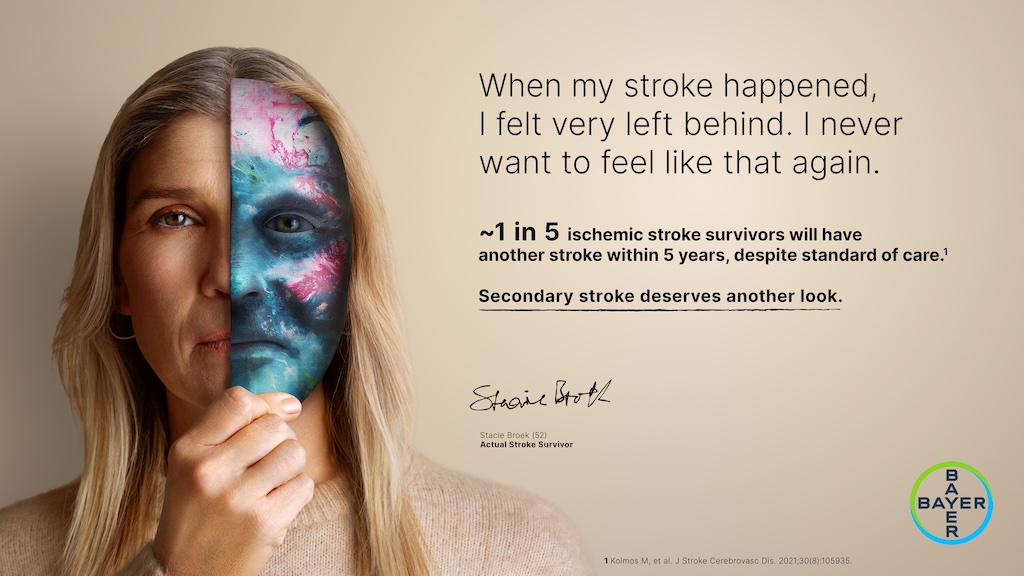
After immersing themselves in each survivor’s fears and hopes, artists Dodo Newman, Blagovesta Bakardjieva and Ulrike Lindner herself created unique images that gave shape to the invisible burden of living with the possibility of another stroke. Stroke survivor Sas Freeman also contributed her own artwork, grounding the project even further in lived experience.
Those artworks were then transformed into striking half-face masks, inspired by one of stroke’s most recognizable symptoms: facial droop.
For Lindner, the symbolism of the masks was central to the project’s emotional impact. “We chose half-masks because they reflect the in-between state many survivors live with. A stroke may be over, but its presence never fully disappears. The masks gave visible form to a fear that is often hidden: the fear of recurrence.”
Once complete, the masks stepped out of the studio and into the world as the centerpiece of “The Invisible Made Visible”, carrying with them the fears, memories and fragile hopes from which they had been made. Launched at the heart of the global stroke conversation, at the European Stroke Organisation Conference 2025, the masks invited audiences to look beyond recurrence as a clinical term and see it for what it often is in the lives of survivors: a shadow, a possibility, a fear that never fully recedes.
There, surrounded by science, data and professional exchange, the masks brought something else into the room. Presence. Vulnerability. Emotion. They interrupted the usual language of medicine with something quieter, more human and harder to turn away from.
That same force traveled through the wider campaign. Across digital and social channels, the masks became a visual expression of what recurrent stroke feels like to live with. They transformed an abstract risk into something immediate and intimate, giving shape to a burden that often goes unseen.
“What makes this DSA campaign so special is that it brings together science, creativity, and most powerfully the authentic voices of stroke survivors,” says Céline Starck, global brand director at Bayer. “It’s their truth, their fear, and their strength calling us to act. It’s more than just awareness. It’s lived experience demanding change in secondary stroke prevention.”
The response proved that people felt it. The campaign generated more than 3,000 congress engagements, over 600,000 social impressions, more than 130,000 video views, and more than 2,000 link clicks. Recurrentstrokes.com also saw strong engagement following launch, with 1,374 users, 2,298 sessions and a 45 percent engagement rate between July and November. Just as significantly, the campaign drove recall among 1 in 2 HCPs.
Yet the impact of the work was not only measurable in numbers. It was present, too, in the emotional responses it drew. One association partner described the campaign as “so touching and impactful” and as “one of the best I’ve seen.”
That is perhaps what “The Invisible Made Visible” achieved most powerfully. It gave recurrent stroke a form. A presence. A face. And in doing so, it made something long overlooked harder to ignore. As Johannes Ottomeyer, creative director at Syneos Health Communications, reflects, “At its core, this campaign was never about adding another message, but about making an existing reality visible.”
“Across all of the ideas explored by the creative teams, this one stood out from the beginning, because it didn’t need to be constructed or staged. It was already there, grounded in something real.”
**This article contains Bayer proprietary research: Bayer. Data on File. Disease burden, unmet needs & FXIa inhibitor class perceptions