Newsletter
 Events

Purple Reign: Roku City Opens Its Gates for TV and Movie Send-Ups
Preacher and Andreas Nilsson provide fresh, funny takes


Sometimes, it’s not what you spoof, but how you spoof it.
Oddball takes on TV and movie tropes have flooded ad channels in recent years. The approach is a trope in and of itself.
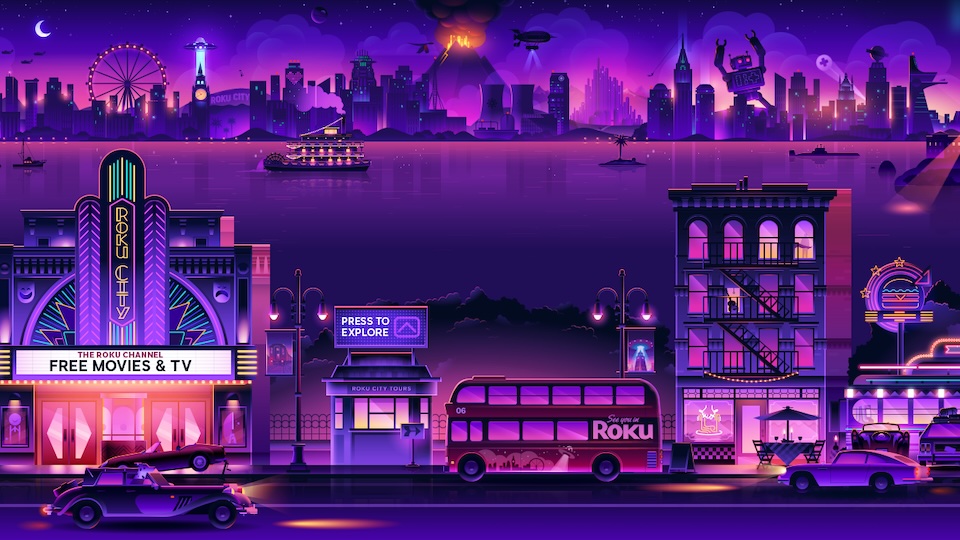
Still, Roku finds a way to make it work, using the brand’s familiar city screensaver as a portal to parodies that ripple with comic energy and visual flair.
Dubbed “See You in Roku” and breaking today, the stylized work from Preacher, Untold Studios and director Andreas Nilsson rocks a distinctive vibe driven by quick cuts, cracking quips and canny use of the platform’s color palette and iconography.
Sure, we’ve seen send-ups of crime shows, medical dramas, adventure fare and sci-fi potboilers before. But these adverts are a cut above, with plenty of offbeat attitude. They’re legitimately amusing and don’t oversell, spotlighting Roku as a source for diverse entertainment.
Moreover, they cast the service as the setting—and by extension, a character—in each storyline. That conceit feels fresh and elevates the whole campaign.
Here, the creators of “See You in Roku” walk Muse through the initiative:
Why use Roku City as the focal point?
Greg Hunter, ECD, Preacher: The screensaver isn’t just unique and ownable, it’s beloved. Online and across social, people analyze, speculate and dream about everything going on in the world they watch scroll by on their TV screens. This campaign embraces that behavior and doubles down on it, treating Roku less like a service to log into and more like a destination to travel to.
And when they see inside the hospital, theater and other familiar landmarks, what’s their takeaway?
Greg Hunter: Roku is the No.1 platform in North America by hours streamed, with a growing community of over 100 million households. In other words, they’re huge. And we wanted these millions of TV lovers to realize they’re not alone, but a part of something bigger. “See You in Roku” is as much a civic pride campaign (in the vein of “Keep Austin Weird” or “I Amsterdam”) as it is a tourism campaign. Roku is millions of people’s home away from home, inside their home.
There’s a lot going on in the vignettes. For you, what stands out the most?
Greg Hunter: There was no shortage of destinations inside the Roku City screensaver—each one providing a different TV or film trope to play with. Bringing these destinations to live-action life was an awe-inspiring undertaking. There was a shocking amount of actual sand brought onto the sound stage to create our desert island. There’s no way they got it all out of there. That place will have sand in its seams for decades to come.
But no set build was more impressive than the full-scale pirate ship, hand-constructed, plank by plank, by an actual Viking shipbuilder.
Finally, beyond the builds, the lighting setups were something to behold. Recreating Roku’s signature purple glow wasn’t easy. But seeing these scenes bathed in a mix of bright violets, rich plums and vivid fuchsia made each set feel truly surreal.
Easter eggs abound. A Survivor legend pops up at one point. Do tell.
Todd Witkemper, Roku senior director of brand and experience marketing: Without divulging anything specific, what I can say is that it’s great to hear that you’ve spotted a few because there was a lot of thought and intentionality behind Easter eggs from the outset. They are such a core part of what makes Roku City unique and delightful for our customers, as well as our focus on participating in pop culture to create a shared experience with viewers. There was no question that we needed to carry that through to the commercials. You’ll see that we’ve incorporated them into everything from props on set to VFX to the actors themselves.
Any worry that TV send-ups have gotten too familiar?
Greg Hunter: It’s a great point, and one we discussed. But that’s where Roku’s signature purple world worked in our favor. Even when the scene or subject matter felt somewhat familiar, the end result never looked like anything we’d seen before. The goal wasn’t to recreate these classic film and TV worlds, but to find Roku’s unique take on them.