Newsletter
 Events

‘Messy Is Good’: An Inside Look at Growing Up in the Droga House
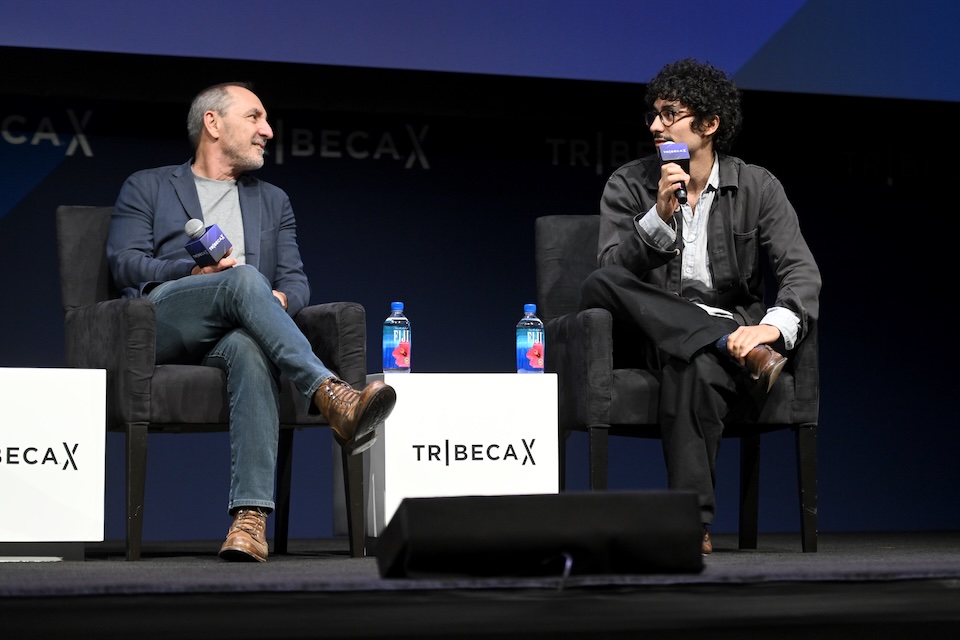
Muse chats with ad icon David Droga and his filmmaker son, Finn, at Tribeca X


Storytelling isn’t genetic, per se. But the play between nature and nurture in the Droga family is well worth exploring.
At this year’s Tribeca X—the Tribeca Festival’s annual celebration of the junction between entertainment and advertising—Muse by Clios sat down with David and Finn Droga. David, an advertising icon with a 40-year legacy of crafting legendary brand narratives—ranging from the Tap Project in New York to a city-wide scavenger hunt for Jay-Z’s autobiography—recently transitioned into the role of vice chair at Accenture following four years as CEO of Accenture Song. His son, Finn, is a USC film school graduate currently preparing for his directorial debut with a coming-of-age feature set to shoot in NYC next month.
The fireside chat explores the parallels between their different forms of storytelling. We cover what it was like growing up in a household where creativity was celebrated (not stifled) and learn of their aspirations as each embarks on a new chapter.
The following has been lightly edited for length and clarity.
Muse: David, to set the stage a bit for our friends in the audience, you are quite the ad legend. In your mind, what makes for a compelling story?
David: A great story is something that connects with you viscerally. No one can determine what’s going to connect with you, but it’s something that moves you and doesn’t just pass over you. A story is something that you can take on board, interpret, and reinterpret, and it connects with an emotional part of you.
Finn, in reading through the premises of your narrative shorts, it seems like you have a focus on the stories centered around almost these ethical dilemmas and personal beliefs. What makes a compelling story in your eyes?
Finn: An interesting story is something that feels like it’s coming from a real place from the writer. You kind of have a duty to take your feelings seriously. If you stub your toe and it feels like the end of the world, then it’s kind of the end of the world. And in that story, why couldn’t it be? It’s all subjective. An interesting story is an honest one.
How was creativity valued and appreciated in the Droga house? Was it hanging art on the fridge? Was it discussing interests and projects at the dinner table?
David: Let me paint a little picture first because there are a lot of moving parts in this household. Finn is one of four siblings. My background is in writing, as a creative, and my wife’s background is in film. So, we both come from a creative background.
It’s a very big, emotional household. There’s a lot of noise, a lot of chaos, a lot of storytelling, music, art—all that sort of stuff. It’s a very expressive household. I always used to joke that it’s like a Viking raiding party because it’s just messy and loud. But from that comes a lot of fun. When I say it’s a creative s*it show, I mean that in a great sense. There’s a lot of spontaneity, a lot of joy, and a lot of tears, and that makes for a really interesting, culturally deep house. It may be messy, but it’s definitely more fun. Messy is good. It’s hard to write about being too polished.
Finn, were you aware in your younger years of your father’s cultural impact in advertising? What are some of the biggest lessons you learned from him growing up?
I’d like to say no, but I was definitely aware of who he was. I used to look up to him a lot. I still do, but I spent a lot of time looking him up, like “David Droga best quotes” on Safari. Maybe I learned from him how to be confident in your own storytelling and believe in your own vision. He probably hates it when it comes to a clash with him when he’s telling me to change some of my writing, and I’m like, “Yeah, I don’t think so.” He’s probably not too used to that.
But he was really the one who put that in my mind: It’s a story coming from you. No one knows how to tell this story better than you do, so you’ve got to believe it. That’s not to say you can’t be open to other people’s opinions, but I think it’s a disservice to your own story if you’re not going to believe in it.
David, when Finn first started showing interest in filmmaking around age 12, what did you learn from his way of seeing the world and the way that he wanted to tell stories?
David: He was always a creative kid and a storyteller, expressive in lots of different mediums. Even though my creative success was more overt, the influence of his mother was probably even more overt. His mother and grandmother were in film; they love film. She would always let him take a day off school once a semester to go and see a film of his choice. So there was no surprise that [film] was something he wanted to do, and I loved the fact that he would just go and do that.
And he had his siblings, whom he’d boss around, and they would always be part-time actors in his diabolical stories—and they were willing. But it was amazing [to see] and he was learning. The funny thing which Finn touched on: I was so used to being the creative director or the leader where people would listen to my opinion, but it was amazing when I would tell Finn something. It’d be like, “Finn, have you thought about this?” And even at a young age, he was like, “Yeah, I’m not sure I like it this way.”
I realized his creativity was so different from mine. His voice, his quirks—everything was so different. I thought, “Well, actually, that’s amazing. I should just get out of the way and be supportive.”
Finn: Growing up in a creative household, creativity was the norm, whether it was creative projects or creative ways to get out of going to bed. It probably would have been harder to pitch going into finance than being a filmmaker.
I have a lot of friends who really had to push their parents to be accepting of them as artists. That’s one of the ways that I feel the most grateful for my family; it was never really a push and pull. I always felt believed in and supported creatively, which I think is so much more special than I could possibly articulate. Luckily for them, I would be terrible in finance.
Finn, tell us a bit more about what you’re working on.
A feature film that will be shooting in the Fall all around the city. It’s a coming-of-age story about these two eighth-grade boys. They’ve been best friends for a long time and they’re dealing with this splintering friendship. It all takes place over one night—it’s on the last day of eighth grade. [But] what it really is about, to be honest and what I was really inspired by, is that really profound age of 14.
For some people, it might be 16 or 12 or whatever. For me, it was 14. There’s that weird time when you get adult-sized emotions for the first time, but you have a kid brain to deal with it. So it’s just really weird and it feels like you change forever.
People, no matter how old, kind of treat their childhood like it’s half their life when, at a certain point, it’s only a tiny fraction. So I feel like that turning point is something that’s inherently profound.
We are seeing things like AI, YouTubers-turned-filmmakers, and short form content emerge. As you enter your career journey, what are your thoughts on the cinematic storytelling landscape? What is the mark you are hoping to leave?
Finn: The landscape is pretty crazy. My dad and I disagree about AI in a lot of ways, but I’m not someone who thinks AI is objectively horrible in every way. It’s the application of AI in an irresponsible way that I have a problem with, and creativity eventually being dictated by people who have never written a story. I have my concerns about minimizing that kind of stuff.
We need to protect the ability to think. It’s not just creative fields; the people making AI are passionate thinkers, and everyone here is as well. We can’t lose that, and that’s what I’m worried about losing in this landscape. It’s great that YouTubers are becoming filmmakers, but I worry about people getting addicted to hype. If you’re so obsessed with being at the cusp of technology, you’re going to forget to lead with thoughtfulness, empathy and love.
You both are in different phases of your career. What is your hope for the other as they embark on their new chapter?
David: I love watching Finn at this infant stage of his career because I have such confidence in him. You hear him talk and you know this is a person who’s filled to the brim with authenticity and potential.
And I can’t wait to see what happens. It’s not like, “Oh, I can’t wait to see him be a success.” I can’t wait for him to be fulfilled and to give what he wants to give. Particularly at this time in the world where we need more storytellers and people who care. There’s never been more necessity for that and I’m excited for him.
Finn: [My dad is] a workhorse. He’s never going to stop working on something, but I hope he can find some time to relax a little bit and chill.He’s a very smart guy and I think he has a duty to keep using his brain. I would never think he would stop, but my hope would be maybe he starts teaching or something. I think that could be a great use of his mind. It could be cool.
Editor’s Note: Production for Droga’s film will begin in Fall 2026, not July/August as previously stated.