Newsletter
 Events

How Goodwipes Spoofed Astra and AI, Butt Good, Using AI as the Key Driver
Human bodily functions x tech = sharp, brand-building satire


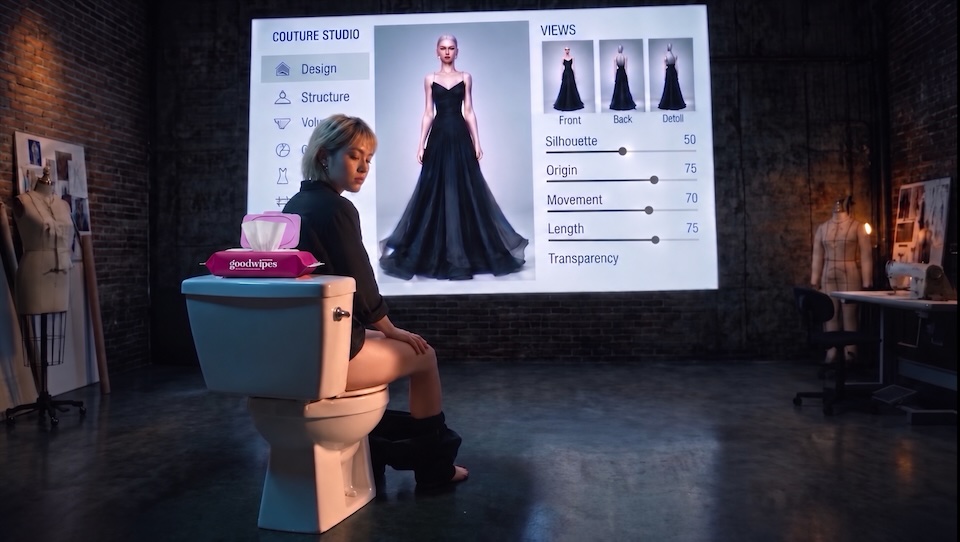
Relax, people, “The next future of butt wiping has arrived.” Thanks, Goodwipes!
The AI-generated :60 below specifically spoofs OpenAI’s derided Astra commercial. But it works equally well as a broader satire of encroaching tech.
Behold the wonders of “Asstra,” which lets users play games, buy stuff and command AI from their commodes.
Of course, we can do all that already. But Goodwipes serves up schlocky sci-fi trappings and fires off flatulence sound effects to sweeten the … pot. And, more pointedly, to make the point that its wet wipes provide a hygienic alternative to traditional t.p.
Bots beat “Buttlers,” apparently. Though Goodwipes was all about the latter in its silly summer storyline with Liquid Death.
Below, Muse rolls through the machinations of “Asstra” with Frank Cartagena, founder and CEO of OK Future, which helped develop the campaign.
Why spoof OpenAI? Will the audience get the joke?
If you have seen the original Astra film, there is obviously another layer to the joke because you understand exactly what we are referencing. But you do not need to have seen it. There is an underlying human truth that makes the idea work on its own. People do all kinds of things on the toilet, whether we like to admit it or not. They answer emails, work, doomscroll, shop, think. And now we have these unbelievable AI tools that allow us to be more productive than ever, including from the toilet.
We actually showed the film to people who had never seen the original, my wife included, and they still understood it and thought it was funny. So Astra gives the idea another cultural layer, but the behavior underneath it is broad enough that the joke still works without the reference.
Where will people see it? When they do, what’s their brand takeaway?
This was designed as an earned idea. You put it online, seed it strategically in the places where the conversation is already happening, put PR around it and then let the internet do what the internet does. Reddit has been a great example. We seeded it into relevant communities there and saw close to 1 million views within the first 48 hours.
The brand takeaway is really simple: If everything else in our lives has evolved this dramatically, why are we still wiping ourselves the same way?
The AI and the parody get your attention, but what we ultimately want someone to think is, “Why am I still using dry toilet paper?” Goodwipes is the upgrade.
Some real actors? A mix?
There was no traditional shoot and the characters are AI generated. But the interesting thing is how similar the process is to making a traditional commercial. You still have to cast, art direct, find your locations and direct performances. You still have to get that nuance right. The difference is that you are directing it through a different set of tools.
Can you expand on the notion of virtual casting?
We created detailed character studies based on who we imagined these people to be. Once we had someone we liked, we created high-resolution reference imagery and dozens of different views so we could maintain the same person across different shots and angles.
We did the same thing with the environments. Continuity became a huge part of the work. If there is a brick wall and shelf behind the interior designer in the first shot, it needs to be the same brick wall and shelf when we reveal that character later. The objects in the background need to stay where they were. You cannot just generate a pretty frame, generate another pretty frame and assume they are going to cut together.
What software did you use?
ArtCraft was an important platform for us in the process. Beyond that, we tend not to get overly specific about the exact prompts, models and workflows. We increasingly think those workflows are intellectual property. Everyone is gaining access to many of the same AI tools, so differentiation is going to come from how you use them, how you combine them and the judgment you apply to the output. And the platforms themselves are changing so quickly that what we use today may not be what we use six months from now.
Working with AI must introduce its own set of headaches.
Every production has its challenges. These were just different kinds of challenges. A traditional commercial might take two or three months from idea to being out in the world. Over that period you go through all the usual production emotions: excitement, frustration, breakthroughs, problems, highs and lows. We basically condensed three months of those emotions into four days. We didn’t sleep very much.
Then there were the uniquely AI problems. AI has guardrails around nudity, which becomes interesting when you’re trying to make a commercial where people are sitting on toilets with their pants down. And for some reason, it really did not want to put the toilet seats up. We kept getting these otherwise beautiful scenes where someone was sitting on a closed toilet.
The tech wanted to keep things classy. Heh.
AI also loves to leave you little surprises. Garbled text, strange artifacts, objects that suddenly change between frames and other little things that should not be there. You have to be incredibly detail oriented at the exact moment when your brain is least equipped to be detail oriented.
It’s also worth mentioning that early on, we all had to agree on a pretty simple question: Does it need to be perfect, or does it need to be out? This was an idea responding to something happening in culture right then. There are even a couple of things in the finished film that we knew weren’t perfect. Some of the Goodwipes products are a little bigger than they should be, for example. There’s some weird text in the Mars scene, but we figured it could pass as an extraterrestrial language of some kind.
We could have kept going and fixing things and making it absolutely perfect, but eventually the value of getting it out while the conversation was happening outweighed another day of polishing. That’s probably one of the biggest lessons from making it. AI can do these incredibly sophisticated things, and then you can lose an hour because of a toilet seat, some garbled text in the background or an object that decided to change shape. Every shoot has problems, and this one was no exception.
What if you had to make this exact same script with zero AI, all old-school. Beyond the tech issues, what’s the biggest difference?
We are very pro-human and very pro-shoot. We want to keep working with actors, directors, crews and production companies. We do not look at AI as a blanket replacement for traditional production. A lot of the conversation around AI is about cost savings. We think that undersells it. It is another tool in the creative toolbox that allows us to bring ideas to life that might not otherwise be possible.
This film is a perfect example. Two years ago, I do not think this idea gets made. To make the exact same script traditionally, we would need multiple actors, multiple locations, a full crew, production design, wardrobe, VFX for the projections, editing, sound, color and all of the other pieces of a traditional production. Even if you moved incredibly quickly, you are probably talking about weeks rather than four days, and a significantly larger budget.
And you needed a quick turnaround, yes?
But the biggest issue is the cultural timing. This was a response to something happening right now. If it takes a month or more to make, by the time it comes out, the reference point may already be gone. That is why this was the right use of AI for us. We were not taking a traditional production and finding a cheaper way to make it. Without these tools, this film just does not exist.
Four days also should not be confused with easy. It was an incredibly intense four days with a huge amount of iteration, judgment and craft. The technology gave us a new way to execute the idea. It did not come up with the idea or make the creative decisions for us.
CREDITS
SVP marketing: Meredith Diehn
Agency: OK Future
Founder: Frank Cartagena
Creative Lead: Mike Palma
Creative producer/editor: Louis Farinella
Editor: Pete Slife
Related: Heidi Klum’s Beside Her (Much Younger) Self in AI-Powered Push From German Fashion House