Newsletter
 Events

Why Immersive Brands Need More Than Spectacle
Today, brand identity is more than optics—it's something you enter and feel


To mark the release of Spider-Man: Brand New Day, Little Caesars and Sony Pictures built a full-scale replica of Peter Parker’s apartment in a Brooklyn warehouse: Spider webs on the walls, an unmade bed, stacks of books and Little Caesars pizza boxes strewn around. No branding pushed to the front, just the brand quietly embedded inside a world that already existed.
Hundreds of fans queued around the block for the one-day experience, where they could explore Peter’s home and try Little Caesars’ new Webberoni Pizza. The idea travelled naturally online too, with creator Caleb Simpson—known for touring people’s houses—giving his millions of followers a tour. Little Caesars had found a natural role within the story, making its product part of the experience rather than plastering its identity over it.
That’s the subtle distinction many teams miss about immersive marketing. They start by asking how to create an impressive experience, rather than what kind of experience makes sense for their brand.
As event budgets grow, this distinction is becoming more important. With 86 percent of B2B marketers and 84 percent of consumer marketers increasing event spending this year, more immersive activations will compete for attention and ROI. But bigger or more technologically impressive doesn’t mean more meaningful. The opportunity is to express something about the brand that other formats can’t.
Coherence Over Consistency
For decades, brand systems were built around consistency: the same logo, color palette and visual language wherever a brand appeared. Those things remain important, but we now experience brands on our phones, at live events, through creators and in physical spaces. Visual consistency alone can’t do the job. Brand identity is no longer simply something you look at; it’s something you enter and feel.
Brands increasingly need to be spatial, temporal, behavioral and sensory. What matters is coherence: the feeling a brand gives you and how it behaves, even when its expression changes.
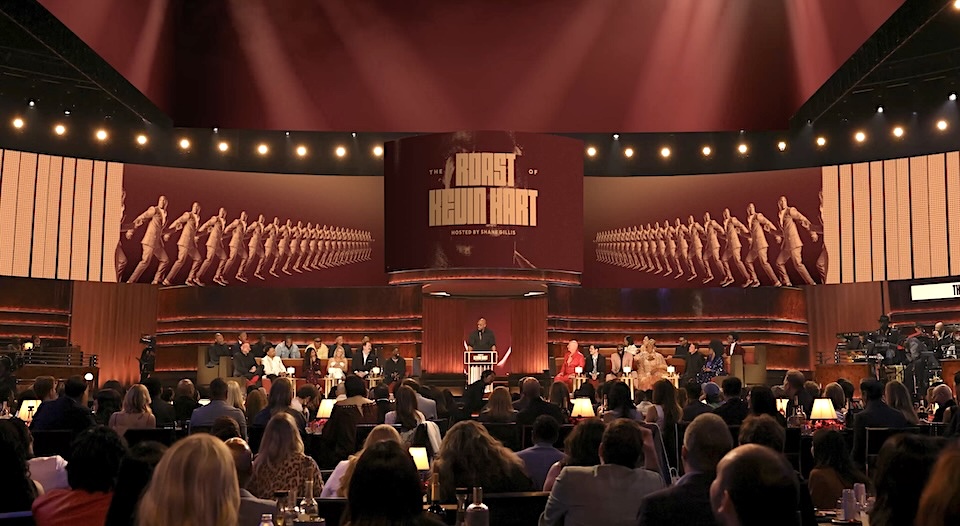
Netflix increasingly extends its identity beyond the screen through Netflix House and live events. For The Roast of Kevin Hart, the closing night of Netflix Is a Joke Fest at L.A.’s Kia Forum, we needed an experience that worked for the audience in the room and millions watching at home. Drawing on championship boxing, the visual identity positioned the roast as a comedy prizefight, with graphics and screen content shifting in response to the comedians. The point wasn’t to reproduce Netflix’s usual branding, but to capture the comedy, culture, celebrity and energy that feels at home on the platform. The special pulled 13.5 million global views in its first week.
Guinness takes the same logic: its Storehouse in Dublin doesn’t merely dress a building in brand colors, it walks visitors through the brand’s own history and craft floor by floor. The architecture couldn’t belong to any other beer brand. In 2024, it attracted 1.65 million visitors, a 10 percent increase from the previous year.
Dive Deeper
Spectacle can get attention, but immersion needs to do more: it should let people experience what makes that brand distinctive. Big screens, elaborate sets, lighting and sound can make something feel important while still giving it very little to say. The useful test is simple: does the experience emerge from the brand, or has the brand simply been applied to it?
When I walked past a recent pop-up in New York, its oversized fruit and yellow and orange sculptural trees certainly caught my attention. But the connection felt superficial: recognizable wellness imagery without much sense of why the experience could only have come from that brand. An activation can be highly branded and visual without telling you anything distinctive. Without that foundation, spectacle quickly feels performative and hollow.
The challenge becomes even clearer when working in large-scale immersive venues with wraparound non-traditional screens, spatial audio and other sensory technology. With these unique venues, spectacle is guaranteed. For the CEO keynote at HPE’s annual Discover conference, we needed to take that spectacle and make it recognizably HPE.
Their brand promise to “Unlock Ambition” gave us that foundation: an abstract idea that the scale and architecture of an immersive venue could make tangible. Working with HPE, we developed a series of cinematic films to take advantage of the epic-scale digital canvases. At their core, the films center on HPE’s commitment to ambitiously advancing AI and human intelligence, fully immersing audiences–figuratively and literally–as participants in the stories. The films sparked something powerful: collective wonder.
The same principle was applied differently to BetMGM’s Court of Legends, where an unused nightclub inside the Bellagio Hotel in Las Vegas became an underground basketball venue built around a 65-panel LED half-court. Different segments had their own identities, from sophisticated Las Vegas for the Cavinder Twins showdown to a rawer Dunk Exhibition. The technology allowed BetMGM to become physical, with the court acting as an engine for live sport, entertainment, spectatorship and betting—behaviors already intrinsic to the brand.
Design the Conditions, Not the Outcome
The most interesting thing about immersive work is that you don’t completely design the experience. You design the conditions for an experience to happen.
As soon as somebody participates, they gain some authorship over it: deciding where to look, what to do and what to share. Increasingly, creators also serve as de facto media outlets. “Court of Legends” didn’t rely on a traditional media buy; its reach came through a livestream and the global creators attending the weekend, who interpreted the experience for their own audiences.
That requires accepting some loss of control. Not everybody will experience or like something in the same way, but that’s what makes participation powerful. A strong foundation lets audiences take an idea somewhere unexpected without losing its connection to the brand.
Ultimately, brands need a strong point of view: an understanding of what they stand for and how that can translate into behavior, feeling and experience. Because when a brand invites somebody into its world, the question they’re really asking is: What are you actually about?
Related: Betting Apps Make Culture Plays With Kevin Hart, Nick Jonas and Jon Hamm