Newsletter
 Events

Inside the Battle for the Soul of Healthcare Creative
The story is the opportunity in front of us


“You’re throwing your career away.”
Those are the words I remember most from my previous employer, after giving notice to start 21GRAMS. It didn’t bother me. It was a little cliché, but I took it as tough love. Their way of telling me I was blowing up a coveted opportunity at one of healthcare’s most creative agencies.
But truthfully, I was struggling with what a “creative agency” meant in healthcare.
It mostly came down to awards; and clearly, the definition was bigger. But awards weren’t the problem. Recognition incentivized creativity, pushing advertising to push itself. An effective carrot, leading agencies to break new ground and constantly evolve what brands could be and do.
Except, in our corner of this universe, no matter how many Lions we stacked on our shelves, they couldn’t hide the elephant in the room. The regulated work clients paid us for was stuck.
And for decades, it had followed the same formula: generic people doing generic things or overwrought metaphors; paired with 10 pounds of information, plus 10 more of branding, in a 5-pound bag.
The potential of an industry that felt so personal, with such built-in emotion and consequential stakes, seemed to be neglected. Thrown away. And no one was all that interested in changing it.
So no, I wasn’t concerned about my career. I was concerned about my industry.
Soap brands were thought-provoking. Sneaker brands were inspiring. And medicine brands got made fun of on Saturday Night Live. While healthcare creatives practically bowed to CDs in other industries, saying, “You work on Burger King? I’m so jealous.”
You work on cancer. Pull yourself together.
I guess what I was yearning for was common sense. And it was right there, in a simple question: Is it more important for fast food or health to be interesting and memorable? Swap fast food with almost any other industry, and your answer should be the same.
Health is the most important thing we have.
Which to me, and many others, meant (and means to this day) that creativity should matter more here than anywhere else. Because it’s one of the few areas of advertising where, every day, we have an opportunity to create an idea that can change actual lives, on behalf of a brand.
To put that in perspective: By doing great work in healthcare, we can make a condition more bearable. Or entertain people into remembering complex information. Or simply help them feel seen in their most vulnerable moments. It’s beautiful, really. And all those things would be good for both the audience and the business.
Yet, for however long this industry’s been around, healthcare is rarely talked about like this. And if it were, you’d see it in the work. But I sense that you’re thinking, “If it were only that easy. You’re leaving out one very important limitation. Regulations.”
Or maybe, just maybe, regulations become healthcare marketing’s favorite scapegoat.
The rules are there to prevent drugs from overpromising what they can do and from burying risks. Most of us (agencies and clients alike) don’t want to do that anyway. Regardless, that handcuffs claim. Not imagination.
Don’t believe me? Read the warning letters. Or have AI read them for you.
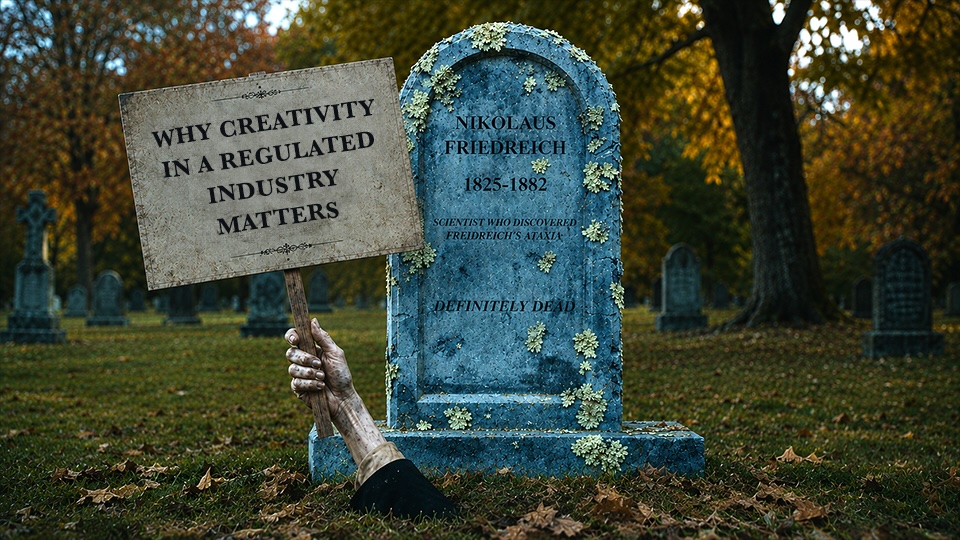
Because history shows that Mr. and Mrs. Smiles Too Much, pedaling a tandem bike, are much more likely to get a marketing team in trouble than resurrecting a 17th century German doctor (literally, from the grave) to teach patients about a treatment for a disease that was named after him. Yes, that really happened.
You may know this campaign as “Friedreich’s Back” for people with Friedreich’s Ataxia. It’s funny. It’s human. It’s effective. Without a single broken rule or client who said, “You know what this genetic disease could use? A likeable zombie.”
It may sound out there, but if we had gone too serious or touchy feely, it would have been condescending. The situation patients were in felt heavy enough, and in this case, the levity was a breath of fresh air.
“But our clients are conservative,” you say.
Are they? Maybe that’s just a stereotype that stops us from presenting our best ideas.
The entire crux of 21GRAMS has always been to understand our audiences better than they understand themselves; to create work that gets them. When you do that, clients are open. Not because they have some natural desire to be brave, but because it’s insightful, on strategy and likely to be effective. The risky idea isn’t risky at all.
And when those go well, clients want more. Even the kind you once labeled “conservative.” So, if the usual reasons aren’t really the barrier they’ve been built up to be, what’s getting in our industry’s way?
The answer might surprise you: healthcare agencies. Let me explain.
Awards, as mentioned earlier, incentivize creativity. Which is a good thing. And when Cannes introduced Pharma Lions and Health & Wellness Lions in 2014; the thought was that it would lead to a creative renaissance on our side of advertising. And it did. Sort of.
See, winning was a huge boost to an agency’s reputation. Especially Agency of the Year. Because that agency could tell clients and talent that they were the most creative healthcare agency in the world. And if you were a CCO or an ECD, there was pressure to show up.
That’s when “the game” started to become more important than the work.
Certain healthcare agencies played it aggressively. I won’t get into all the tactics they use to gain an unfair advantage, because that seems petty and unproductive. But the shows police it as well as they can, and we’ll leave it at that.
The real issue is, the game has never favored regulated, paid-for client work.
There, the degree of difficulty for great ideas to see the light of day is higher than anywhere else in advertising. It has to pass multiple regulatory reviews and other unexpected shrapnel; while fighting off death by a thousand cuts like a scene from Kill Bill.
And if it survives, unscathed enough to be award-worthy, it gets to compete against unregulated work funded by an agency. Which amounts to what can be categorized as a professionally done student project.
The consequence of this is that there’s no incentive to do great regulated work. It’s harder, puts you at a disadvantage, and if you don’t waste your best talent grinding it out on client work—you’re much more likely to get the glory. Which is good for new business, reputation, etc. Clients don’t make the distinction or realize it has little to do with the work you do for them.
“But what about Pharma Lions?” I pretend you ask. “Surely, it’s for the best regulated work in the world. If not, why exist?”
Well, last year I asked the same question. And credit to the Cannes Lions team, they entertained it. So why, in 2026, does Pharma Lions still have a gaping loophole for unregulated work? They discussed with other creative leaders from healthcare agencies, who apparently objected. And I’ll let you draw your own conclusions as to why.
Despite it all, I’m optimistic.
Why? We’ve been working on an experiment. To incentivize the industry to do great work for clients, one of the goals of 21GRAMS (from the beginning) was to prove it could consistently be done.
There’s never been a special team working on awards. Just special teams working on brands across the agency; trying to create the best work of their careers, to build a connection between our audiences and medicine. Each time, pushing the industry forward in almost invisible ways that add up.
Ninety-five percent of the shortlists and statues we’ve won, at every international show, have been for client work. Breaking through, specifically, at Cannes in 2025. Where (despite the unregulated loophole) our work was over a quarter of the Pharma Lions shortlist. Across 7 distinct clients, by 7 different teams. 4 of which were branded, with fair balance and all.
Including the first Gold Lion in over a decade for branded pharma work.
Did we win Healthcare Agency of the Year? No, and that’s okay. But the agency who won didn’t even shortlist for regulated work. And they got to tell their clients that they were the best in the world, as if it was work they’d do for them. And that seemed like a bait and switch.
But still, that isn’t the story.
The story is the opportunity in front of us.
If you work at a healthcare agency; know that we are at a watershed moment, where we can elevate an industry that lives depend on. I think most of you will agree that that’s long overdue. So please, make your client work your best work. You’ll win a little less, maybe. But the impact you’ll have will be immeasurably more.
All you have to do is remember that the standard shouldn’t be lower because this is health. It should be higher because there’s more at stake.
And to me, that was more important than the possibility of throwing my career away. Because what good is working your way to the top of something you can’t help make better, at scale, without taking that leap?
In the long run, for any of us, it will feel more fulfilling than any accolade. But it will take more than a person and more than an agency. Because what our industry’s legacy is, will take all of us.
21GRAMS is there for it. Here’s to hoping you will be too.

Frank Mazzola is a founder and leader of 21GRAMS, part of Real Chemistry; he also serves as global CCO at the latter.