Newsletter
 Events

Canadians Like to Root for Opposing Teams. And FanDuel's Got the Scarves to Prove It
Pair-able wearables for World Cup watchers


Back in January, the Canadian National Junior Hockey team faced Slovakia in the World Junior Championship. While watching the game with my mother, who fled from Slovakia to Canada in her 20s, I told her she had to pick a side. She thought it over for a moment and then quietly but confidently said, “No, I don’t.”
For many sports fans, this is blasphemy. But for many Canadians, at least when it comes to international competition, this is simply sport. And it’s something that will be on high display during the 2026 World Cup.
In many countries, national team allegiance is straightforward. You support the country where you were born. But in Canada, especially in cities like Toronto, where culture is less melting pot and more mosaic, fandom is often layered. You can grow up here while still feeling deeply connected to another nation through family, heritage, culture or identity.
That reality becomes especially visible during major international tournaments. Growing up in Toronto, I could often tell who won a match simply by listening to which neighbourhood the post-game car horns were coming from. And as this year’s tournament fires up, we’ll see pretty much all 48 flags flapping on fans’ cars and draping around fans’ necks. And yet, all those fans will know all the words to O Canada. Because here in Canada, many fans aren’t conflicted about supporting two teams. They’re proud of it.
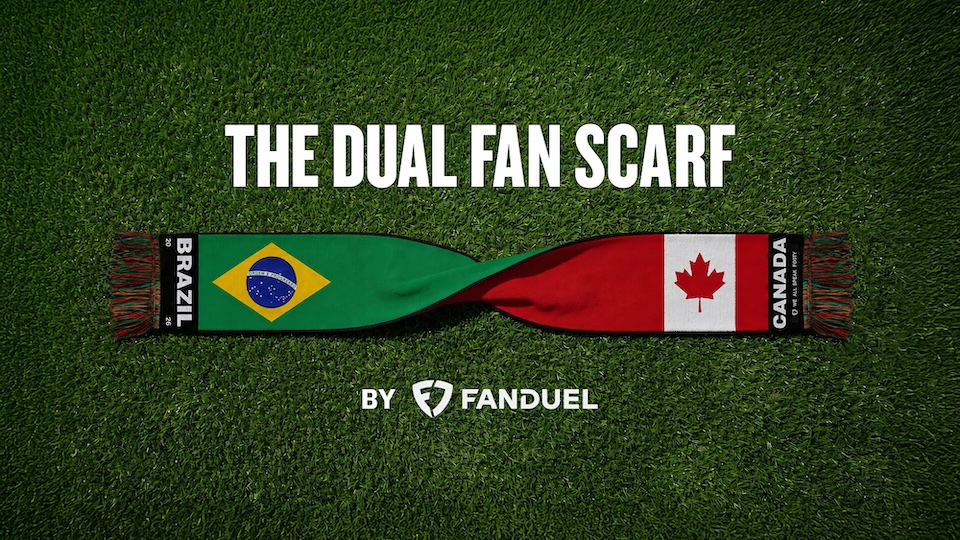
That became the starting point for FanDuel Canada’s “Dual Fan” campaign.
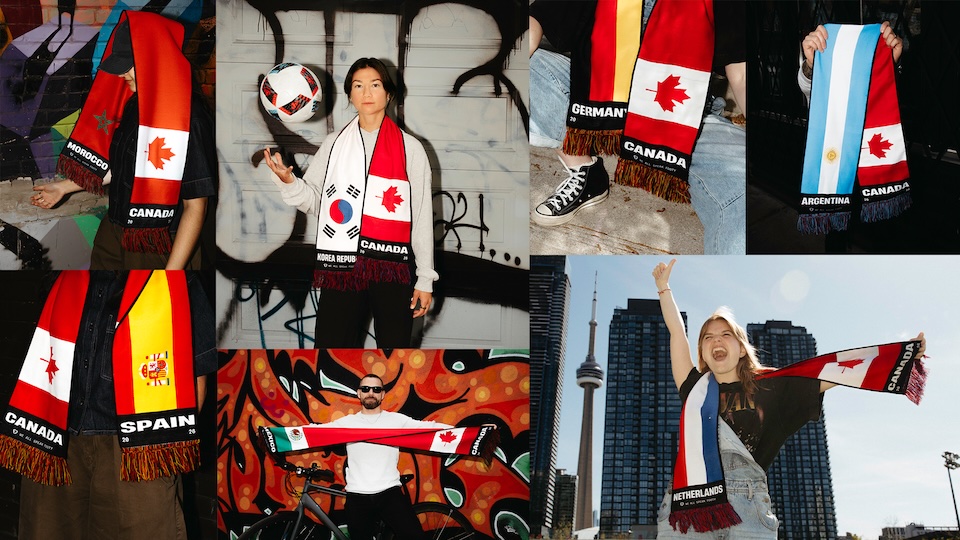
We designed a collection of limited-edition dual-sided football scarves pairing Team Canada with each of the other 47 participating nations. The idea was simple: take something that already exists culturally and make it visible in a way fans could literally wear.
The project was inspired not only by observation, but by data. New Angus Reid research commissioned for the campaign found that 43 percent of Canadian football fans plan to support more than one nation during this summer’s tournament. Heritage and family connection emerged as the primary drivers behind second-team support.
Those numbers felt uniquely Canadian.
Canada is home to more than 8.3 million newcomers and communities connected to over 200 nations worldwide. In a global city like Toronto, multiculturalism isn’t an abstract idea. It shapes neighbourhoods, languages, restaurants, celebrations and, increasingly, though unsurprisingly, sports fandom.
As a creative team, we were interested in treating that complexity as something worth celebrating rather than simplifying.
Design became an important part of that. The scarves needed to feel authentic to football culture first and foremost. They couldn’t look like novelty merch or corporate mashups. Every pairing had to feel balanced and wearable, whether someone was connecting Canada to Ghana, Germany or Brazil.
What I love most about the project is that it reflects something true about this moment in Canada. International football here isn’t just about sport. It’s about identity, migration and belonging.
The campaign simply gave people a way to proudly put all that on display.
The Dual Fan scarf execution is part of FanDuel’s broader “We All Speak Footy” platform, which spans broadcast, out-of-home, digital and experiential activations across the city.