Newsletter
 Events

Carter Center Film Explores Civility and Democratic Participation at a Time of Intense Division
A common sense message for Voter Registration Day and beyond


Two old friends with different opinions on just about everything trek out for an outing in the Georgia wetlands. When their conversation turns to politics, it’s no surprise that they disagree.
Here’s where things get weird… They don’t raise their voices, hurl profanities or throw punches. Instead, each respectfully notes the other’s opinion and they head into town for lunch.
Such civility feels almost quaint here in polarized 2026. But “Common Ground,” a short from the nonpartisan Carter Center and writer/director Nate Townsend, timed to National Voter Registration Day, makes its point in thoughtful, bucolic fashion.
For cynics, the film’s 2 minutes will feel like a throwback to times long gone. Still, it’s never sappy and delivers a hopeful message with heart, suggesting, perhaps, a roadmap for the future.
Here, Muse and Townsend—whose commercial credits include AT&T, Ford and EA—chat about how the Carter Center project developed despite snappy gators and a clunky truck.
Do you have a personal stake in the issue?
My father grew up in Jacksonville, Fla., and my grandfather first took me into the Okefenokee Swamp, where we shot the film, as a kid. Like a lot of families, mine spans the political spectrum, and I’ve seen how quickly disagreement can drive us apart. I wanted to make something about choosing to stay connected anyway—to each other, and to the democratic process.
What served as your inspiration?
I was drawn to the challenge of landing such an earnest message at a moment when political discourse feels so cynical. A “come to the table” message can almost feel impossible to accept right now—everyone’s at their battle stations. But you don’t have to surrender your convictions to get along with somebody. You can believe deeply and fight hard for what matters, and still begin from a place of respect and curiosity about the person across from you. Meaningful change has to start there.
Tell us about the cast.
I collaborated with my longtime casting director, Becky Wu of Orange Street. Because this kind of message can so easily feel inauthentic, casting was everything. We needed two guys who understood the nuance of the film, believed in what it was saying, and didn’t mind spending a couple of days trekking through mud.
We cast nationwide and landed on Tony J. Scott (The Equalizer, Manhunt) and James Healy Jr. (1923, Killers of the Flower Moon). Tony is a Navy combat veteran, and James is a former Texas police chief. As it turns out, they’ve known each other for years. James picked Tony up in Atlanta on his way to Folkston—the bickering started there and carried through the rest of the shoot.
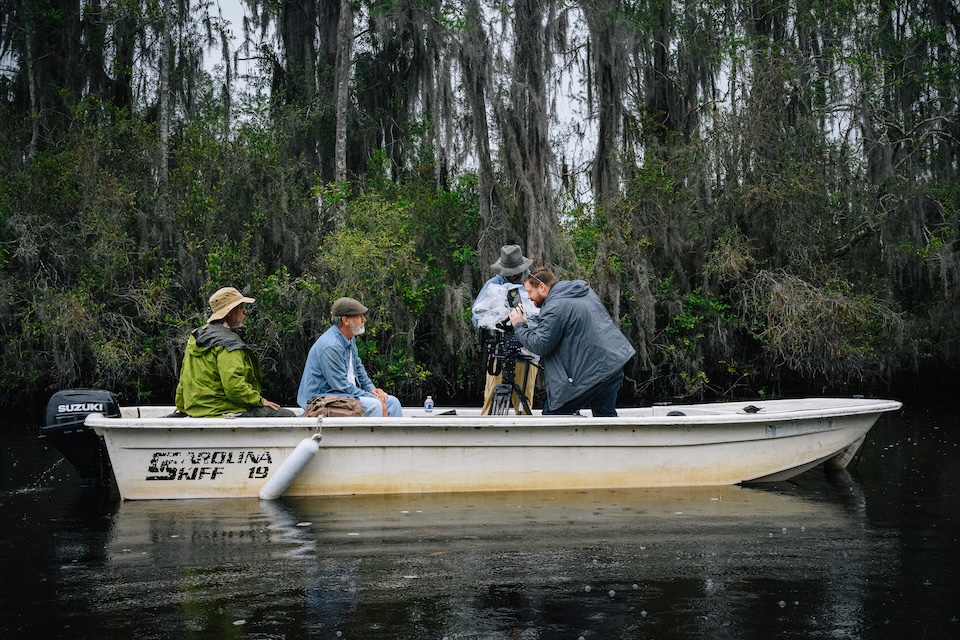
The locations are very evocative. You can almost smell those cypress trees.
We filmed in Folkston, Ga., and inside the Okefenokee Swamp Wildlife Refuge. These locations were central to the film for a number of reasons. First was that Southern Gothic atmosphere—the swamp has this incredible beauty, but also a heaviness and formidability that felt right. On that note, the difficult terrain was doing the work of saying: “If these two guys can travel through this to cast their vote, what’s your excuse?” But it also serves as a nice metaphor for the moment we’re in. Democracy, finding common ground—it’s hard work.
You shot on Super 16mm film. Why was that?
To give the film a sense of grandeur and permanence that felt fitting for the message, while also nodding to Jimmy Carter’s era of politics. I wanted to balance the grounded performances with something a little more cinematic and aspirational. A reflection of a place we may not see much of in our politics right now, but should still be aspiring toward.
Must be some adventures from the making-of. Do tell.
It was my first time working with most of these guys. And our first scene on day we’re boating out into one of the most gator-infested bodies of waters in America. Literally, gators all over. I definitely clocked some nervous looks. Luckily for all, my longtime guide Dan Jones from Okefenokee Adventures kept us out of trouble.
The closest we came to disaster was the morning of day two. The truck, a manual transmission I had sourced on Facebook marketplace, would not start. We had shot enough of it on day one that switching it out was not an option. And with a day ahead of truck material (the entire second half of the spot), things were precarious. Somehow, after an hour, James Healy Jr.—fresh off driving Model Ts on 1923—fired her up, and we kept it on for the rest of the day. Thanks James!
The USA’s so divided. Can one more PSA make any difference?
I know “Common Ground” might strike some people as idealistic, overly-optimistic, and perhaps even provocative. And that’s partly what drew me to this one. Maybe right now, finding a way to live with each other is actually the more radical message.
Are we changing hearts and minds with this one? Maybe not. But if it gives us a reason to consider, even for just a couple of minutes, that we’re not as irreparably broken as we think we are, I think that counts for something.
Related: Craft Brewer Protests ICE’s Presence at World Cup