Newsletter
 Events

Samaritans Ireland Asks the Public to Donate Their Voicemails to Help Save Lives
Putting the org's info on outgoing messages


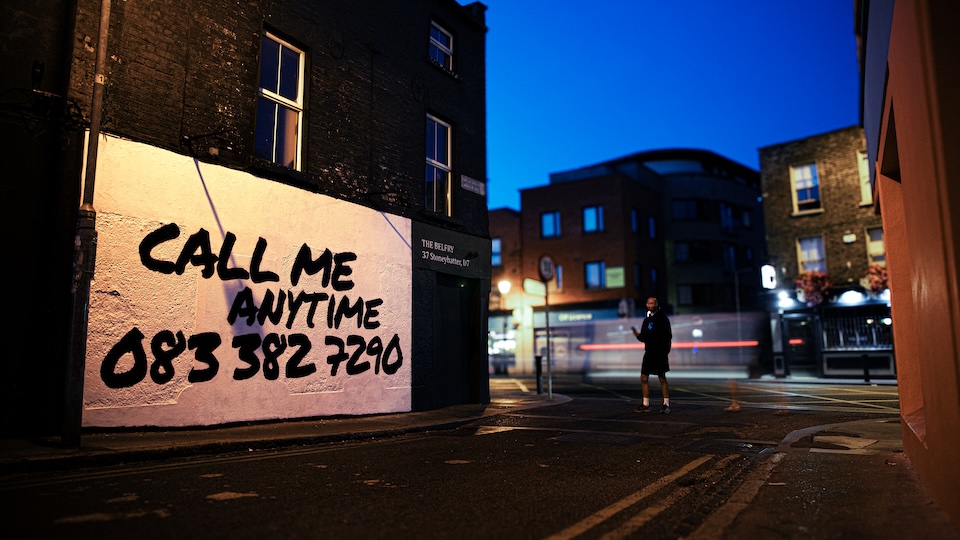
Often, the most important step to getting help is knowing when and where to find it.
But suicide ranks as the leading cause of death among folks aged 18-35 in Ireland, and research by Samaritans showed most people don’t know their mental-health support services are available 24/7/365.
So, the charity and Droga5 began getting the word out in digital and IRL spaces with help from celebs like the Corrs and Premier League player Damien Delaney. The work also features stories from survivors and leverages OOH and social media, urging everyday folks to add Samaritans info to their outgoing voicemail messages.
“The idea really came from looking at something very ordinary and asking if it could do something more meaningful,” Droga5 Dublin CCO Jen Speirs tells Muse. “In our previous highly effective project with Samaritans, ‘The 26th Minute,’ we had seen how powerful it can be when you take an everyday behavior and use it to make people pause for a second.”
“For this campaign, the problem was very real: People didn’t know that Samaritans were available 24/7. So, Samaritans was seeing fewer calls come in after hours, even though those late-night or early-morning moments can be when people feel most alone. That felt like an important space to step into.”
Since launching late last month, the work has generated some 560,000 views with zero media spend, a 99.8 new user spike on the Samaritans site.
Below, Muse delves deeper into the initiative with Speirs.
MUSE: Where’d this idea spring from? What was the inspiration?
Jen Speirs: We all know what it feels like to call someone and not get an answer, to hear that voicemail kick in and feel that small moment of disconnection. For most of us, thankfully that’s nothing more than a bit frustrating. But for someone who is struggling, that feeling of not being able to reach anyone can be really heavy. So the thought was: what if that voicemail moment could become a reminder that someone is always there to listen?
Seems like you’re targeting the broadest possible target audience, which makes sense.
The audience is literally anyone. Anyone who needs to hear that support is there, and anyone who wants to help someone else hear that it is. Mental health struggles don’t belong to one type of person, one age group or one background. They can touch anyone. So we wanted the campaign to feel open, simple and easy to take part in, whether you were someone who might one day need Samaritans yourself, or someone who wanted to quietly help spread the message for others.
And voicemail is so ubiquitous, though largely overlooked beyond the obvious utility.
Voicemail felt right because it is such a familiar part of how people connect. Particularly in Ireland, where people still make a lot of traditional mobile calls. So instead of asking people to download something, go somewhere or learn something new, we met them in a place they already understood. A voicemail is personal. It is someone’s own voice, on their own phone, speaking to someone who was trying to reach them. That made it feel like a very natural home for a message about listening.
It’s more immediate than, say, a typical batch of commercials.
This message is far too important to risk people not noticing it—so we knew we wanted to show it, not just say it. We obviously didn’t have the budget for a big traditional campaign, so we had to find a different way in. Voicemail gave us something more personal, and it’s a space that hasn’t been used like this before. It’s perfectly targeted, because it lets us get to people in a very real moment, literally when they’re trying to reach another person.
The other thing is, beyond the donated media, it was people that gave this idea life. A lot of big sport, music, influencers and radio personalities donated their voicemails, then shared with all their followers that they’d done so and encouraged them to do the same. So it was just so fantastic seeing the idea spread right around the country, with more and more people donating their voicemails to help people know that there’s always, always help if they need it.
What was the hardest part of putting this together?
Probably the responsibility of it. We were asking real people to share stories connected to some of the most difficult moments in their lives, and that isn’t something you can treat like normal campaign material. We worked really closely with Samaritans and with the people who shared their experiences, listening carefully and checking ourselves constantly.
Did making the campaign change you in any way?
It reminded us that this is an issue almost everyone is close to in some way. Maybe they have been through something themselves, maybe they have worried about someone they love, or maybe they have lost someone. That made the work feel very personal for a lot of people on the team. It was not the kind of brief you could keep at arm’s length. You felt the weight of it, but also the privilege of being able to do something useful with it.
The strength of this idea is in its simplicity. I mean, changing a voicemail is not a big dramatic act, but in the right context it can reach someone at exactly the right moment. It’s a great reminder that sometimes the most human ideas are the simplest ones. They don’t need to shout. They just need to be there when someone needs them.
CREDITS
Agency: Droga 5, part of Accenture Song
Creative Director & Concept: Carina Caye
Creative Director & Concept: Alex Ingarfield
Senior Product Designer: Leah Griffin
Group Creative Director: Stephen Rogers
Senior Copywriter: Rudhraigh McGrath
Group Creative Director: Pieter Konickx
Associate Creative Director: Anthony Ortuso
Account Director: Aoife Hearne
Project Director: Caitriona Coakley
Creative Technologist: Elite Sher
Head of Production: Jessica Bermingham
Producer: Sarah Chadwick
Business Affairs Director: Christina McGuckian
Business Affairs Manager: Dominique Mulvaney
Editor: Adam Kelly
Motion Designer: Cris Schmidt
Photographer: Eoin Lennon
Finished Artist: Louise Quigley
Strategist: Ciara Murphy
Head of Engagement: Emer Fitzgerald
Chief Creative Officer: Jen Speirs
Chief Executive Officer: Jimi McGrath
Chief Strategy Officer: Emma Sharkey
Samaritans Ireland
Executive Director: Sarah O’Toole:
Communications and Policy Manager: Sarah Stack
Policy and Communications Officer: Brian Mannion
Partners
Chris Doyle and team, Bauer Media Audio Ireland
Chris Cashen and team, WPP Media Ireland
Priscilla Kotey and team, Warner Music Ireland
Emma Kelly and team, Elevate PR
Mick Ellis and team, Screen Scene
Keith Hughes, KL Studios
Dave Beirne and team, Collective
Cormac Dillon and team, Mack Studios
Colin Maguire and team, The Hot Box Sauna