Newsletter
 Events

How Kotex Crafted One of the Year's Boldest Health Campaigns
The inside story of the Grand Clio winner praised for its intense imagery and uplifting message


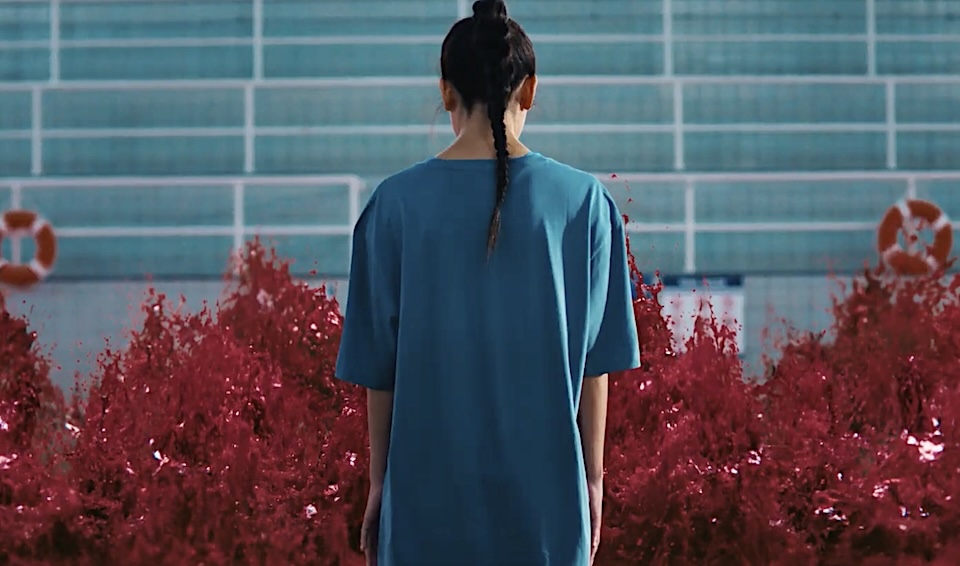
While developing the visuals for “Own Your Flow”—the audacious campaign from Kimberly-Clark’s Kotex designed to break taboos around women’s periods—the team at Melt Creative in Barcelona faced a potent challenge.
Bathed in bold hues, with imagery ranging from a fiery tennis court to surging waves of red, the story asked the audience to believe they were watching the same person from age 12 to 30 and form an emotional connection.
“That sounds straightforward on paper,” Melt’s VFX EP and head of production Olaia Casal and VFX supervisor Albert Garcia tell Muse. “But it became incredibly complex in practice. We were working with different performers, limited shooting time with minors and live singing performances where even the smallest facial detail mattered.”
“The real headache was preserving identity. It’s one thing to make someone look similar; it’s another to preserve the tiny expressions, emotions and nuances that make them feel like the same person.”
The solution, appropriately enough, involved going with the flow and developing a hybrid approach combining AI, traditional VFX, photogrammetry, compositing and a huge amount of painstaking refinement.
“There wasn’t a single breakthrough moment,” the creatives recall. “Just a lot of talented people solving one problem after another until it finally clicked.”
Set to Tears for Fears’ “Everybody Wants to Rule the World,” the :90 from director Juan Cabral dropped in February. It generated copious coverage around the brand’s message of empowerment for girls and women facing social and personal pressures, urging them to own their journeys in the face of challenges and anxiety.
Last night, at the Clio Health Awards, the project—begun by FCB and led by McCann—took home a Grand, lauded for film craft and visual effects.
Here, Casal and Garcia walk Muse through their creative process:
MUSE: Tell us about mixing old-school F/X with cutting-edge tech.
Olaia Casal and Albert Garcia: On set, we combined practical elements such as water and dust explosions with large-scale simulations. In post, we built a surreal CG tennis court, digital crowds, CG balls and countless effects that helped tie the whole world together.
The challenge was making everything feel tangible and cinematic while still existing in a slightly dreamlike space.
Our goal is never to create VFX that calls attention to itself. Quite the opposite: The best compliment we can receive is when viewers don’t notice the visual effects at all, because they feel completely integrated into the art direction, cinematography and storytelling of the film.
How did AI come into play?
In helping us tackle the heroine’s transformation across different ages. But contrary to some assumptions, AI wasn’t a magic button. It became one tool among many. We combined AI-generated passes with extensive compositing, 3D work, paint, retouching and manual lip-sync corrections to make sure every performance felt authentic. In the end, the craft was about balancing technology with human artistic control.
Was there a time when you got so frustrated, you thought you might have to give up?
There were definitely moments when we wondered whether the solution we’d spent days developing was actually going to hold together. The roughest patches came when we realized that techniques that worked beautifully in still images didn’t necessarily work in motion. As soon as singing, emotion and performance entered the equation, the level of complexity increased dramatically. We found ourselves constantly testing, refining and rebuilding processes. At times it genuinely felt like we were building the plane while flying it.
Any big surprises?
One of the biggest surprises was discovering just how powerful the collaboration between different disciplines could be. This wasn’t a project where AI replaced traditional VFX, or where one department carried the work. It became a genuine collaboration between artists, compositors, 3D teams, technologists, production and creative leadership. Everyone was constantly learning from one another.
Juan Cabral came with a very ambitious vision, and he was deeply involved throughout the process. There was a constant exchange of ideas, references, tests and discoveries. Some of the strongest moments in the final film weren’t the result of a single breakthrough, but of that ongoing collaboration and willingness to keep pushing until every detail felt right.
After months of testing and refinement, there were moments when we’d look at a shot and stop thinking about the technology altogether. We were simply watching a character. That’s when we knew we were getting close.
Did this project change you in any way?
Absolutely. We come from traditional VFX, a process built on control. This project changed that. We replaced the pipeline with a loop—a mindset where ideas evolve, adapt and reshape the work at every stage. AI became both an opportunity and a risk, forcing us to design with uncertainty and build parallel paths forward.
Innovation isn’t about the tools you use. It’s about how you think: staying curious, embracing experimentation and being willing to rethink your approach as you go.
Int the end, art leads and technology follows.