Newsletter
 Events

How a Curious Robot Helped Launch Quechua's New Hiking Shoe
Inside the Orès campaign


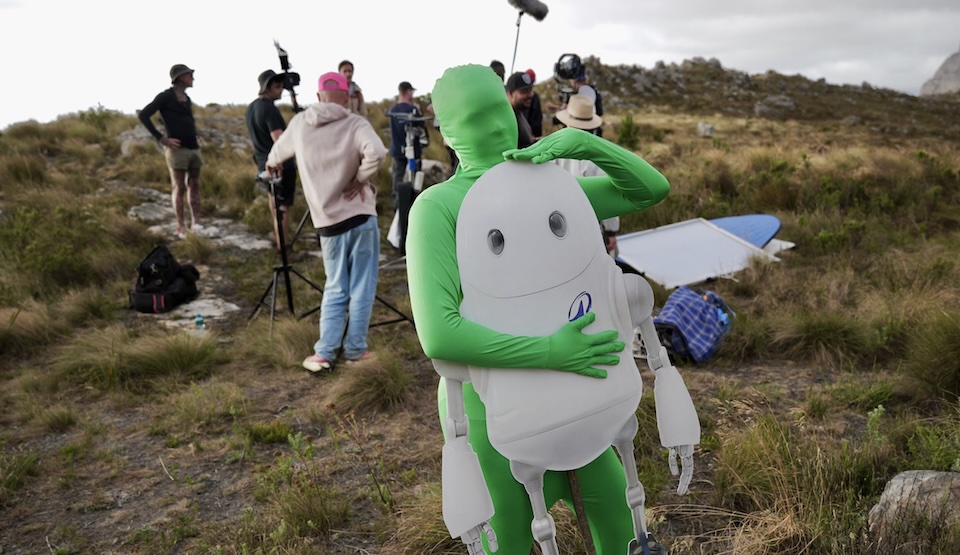
Every brief carries a hidden question. For Quechua’s launch of the MH900, their premium hiking shoe, the question wasn’t just about how we’d showcase this product. It went deeper: How do we remind the world what this brand is actually built on?
Quechua has always been rooted in R&D, in the obsessive, quiet work of engineers and field testers who push gear to its limits before it ever reaches a trail. Our job was to make that DNA visible and memorable.
We explored several creative territories. One stood out immediately: a robot. Not as a gimmick, but as a narrative device. What if Quechua’s own precision and engineering culture had literally come to life?
That idea became QUECH-01: a rogue prototype, born from a technical incident at the design center in Sallanches, in the shadow of Mont-Blanc. Driven by something it can’t quite name, the robot escapes and takes the MH900 into the wild terrain it was built for. Mountain passes, rocky ridgelines, the kind of environments where gear either holds up or doesn’t.
But the story has a twist. QUECH-01 can measure everything. It cannot feel anything. And that gap, between data and sensation, between precision and experience, is exactly where Quechua lives.
The film ends not with the robot’s verdict, but with the viewpoint of humans: the brand’s testers and engineers, whose sensory knowledge of the field remains the only validation that counts.
To tell that story visually, we needed a production approach that mirrored the film’s own argument: technology in service of the human vision, not the other way around.
Orès Collective orchestrated a fully hybrid workflow. Band Originale handled live-action cinematography alongside 3D and VFX work. They also developed the AI-generated sequences and integrated them into the edit.
The central challenge was aesthetic coherence. AI-generated imagery can quickly feel unmoored from reality, too clean, too uncanny, too generated. Our teams spent significant effort on the question of how to use AI without undermining the visual integrity of the real footage. The answer came through tight collaboration between the live-action and AI teams at every stage, treating the AIGC sequences not as a separate layer but as part of a single visual language.
The result: situations that would have been impossible, or prohibitively expensive, to capture on location, rendered with enough visual truth to hold their place in the film.
Why it matters beyond this project
We work under real constraints. Budgets don’t stretch indefinitely. Neither do timelines. But that’s precisely where hybrid production earns its place, not by cutting corners, but by expanding creative ambition within the limits that actually exist.
For a brand like Quechua, that ambition has a strategic dimension too. When clients can see ideas rendered convincingly from the earliest stages of collaboration, internal alignment happens faster. Teams get excited together, earlier. And the creative territory a brand can claim, globally and coherently, becomes larger.
QUECH-01 escaped the lab. The real story is about what brought it back.